
What Is Intelligent Network Observability?
Part 2 of a Four-Part Series: The Future of Network Operations

- By Heidi Gabrielson
- 21-Sep-2026
In the first blog in this series, we explored how the network has expanded beyond its traditional boundaries, creating new blind spots and complexity for NetOps.
Meeting that challenge requires more than broader visibility. Network teams need to correlate evidence across the environment, understand what it means, determine what matters, and what to do next.
That’s Intelligent Network Observability.
Intelligent Network Observability combines high-fidelity network evidence with contextual correlation, AI-powered intelligence, and automation to help NetOps identify and prioritize issues, collect evidence for an accurate diagnosis, and then recommend the remediation. Over time, organizations can increasingly automate remediation for common, well-understood, and repetitive issues.
The goal is to move network operations from reacting to problems toward predicting, preventing, and resolving issues before users and the business are disrupted.
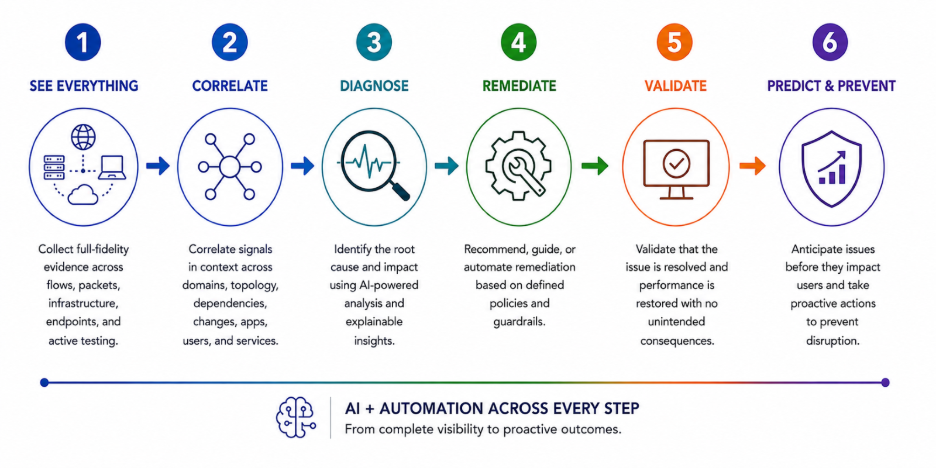
1. See Everything
As we explored in Part 1, Autonomous operations start with enterprise-wide, high-fidelity network visibility across flows, packets, infrastructure, endpoints, and active testing.
Each provides a different view of network performance. Together, they provide the breadth and depth needed to understand what users are experiencing, what is happening across the network, and where problems may originate.
That comprehensive, high-fidelity evidence is the foundation for Intelligent Network Observability. But evidence alone isn’t enough. NetOps still needs to make sense of how it all fits together.
2. Correlate in Context
AI correlates telemetry with topology, dependencies, changes, applications, users, and services to understand what’s happening, what’s related, and who or what’s affected.
Instead of requiring operators to manually correlate signals across tools and domains, the context comes together automatically.
Traditional monitoring puts the burden on operators to connect the dots.
AI shifts that burden. AI can correlate evidence across domains and interpret it in the context of topology, dependencies, recent changes, etc. to understand what’s happening, what’s related, and what’s affected.
Context matters because individual signals rarely tell the entire story. A spike in latency might be interesting. Correlate it with retransmissions, a recent infrastructure change, a degraded network path, and affected users, and it becomes much more meaningful.
This is where network observability starts becoming intelligent.
3. Diagnose with AI
Once the evidence is correlated, AI can reason at a scale and speed that would be difficult for an operator to replicate manually.
Instead of requiring NetOps to sift through dashboards and alerts, AI can identify anomalies, diagnose likely root cause and impact, and provide evidence behind its conclusions.
The result is clearer answers: Here’s what’s happening. Here’s who’s affected. Here’s the likely root cause. And here’s the evidence that supports it.
Conversational interfaces can make this even easier, allowing operators to ask additional questions and interact directly with their observability data.
4. Remediate with Guidance
Knowing the root cause is valuable. Knowing what to do next is even more useful.
AI can recommend the best response, explain why, and guide operators through resolution. Over time, as confidence grows, organizations can give AI greater authority to execute responses for common, well-understood problems.
NetOps teams determine where AI recommends, where human approval is required, and where AI is authorized to act autonomously within defined policies and guardrails.
Greater autonomy remains governed, with authority expanding only where organizations choose to grant it.
5. Validate the Fix
Fixing the problem isn’t enough. NetOps needs to know whether it worked.
Validation should be built into the resolution process. After remediation, active testing verifies that the issue is resolved and performance is restored.
6. Toward Zero Disruption
The goal isn’t autonomy for autonomy’s sake. It’s minimizing disruption to users and the business.
That’s Zero Disruption IT: shifting NetOps from reacting to problems toward predicting, preventing, and autonomously resolving issues before they impact users.
IT organizations will progress at different speeds, and different use cases will reach different levels of autonomy, but the direction is clear. Ensure network operations can anticipate problems, intervene earlier, and prevent business disruption.
Putting it all together
Together, these capabilities create a fundamentally different model for network operations. NetOps moves from manually piecing together evidence across tools to an intelligent workflow that connects visibility, context, diagnosis, remediation, and validation. The transition won’t happen overnight. Organizations will progress use case by use case, expanding the role of AI and automation as confidence grows and moving steadily toward more proactive and autonomous operations.
