From AI Ambition to Trusted Autonomy: What It Will Take to Achieve Autonomous IT Operations
New Riverbed research reveals how 1,200 IT and business leaders view agentic AI, autonomous IT operations, AI governance and the challenges of operationalizing AI at scale.

- By Jim Gargan
- 13-Oct-2026
AI has moved beyond experimentation and into the IT operating model. Organizations are placing big bets on it to accelerate innovation, improve operational decision-making and transform how IT teams work. But as enterprises move toward agentic AI, many still question whether they’re ready to trust AI to take meaningful action without human oversight.
That’s what Riverbed’s Global Survey 2026 set out to examine. We surveyed 1,200 business decision-makers, IT leaders and technical specialists across seven countries to understand how organizations are approaching agentic AI, where they stand on the path to autonomous IT operations, and what is standing in the way.
The Race to Autonomous IT Has Begun
Agentic AI is quickly becoming a strategic priority. Every organization surveyed says autonomous AI matters to its business strategy in 2026, with 76% calling it a critical or very important priority, and 90% say they want to use agentic AI over the next two years to achieve autonomous IT operations. They’ve already seen the value, too: 91% of IT leaders at these organizations say their AI investments have met or exceeded ROI expectations.
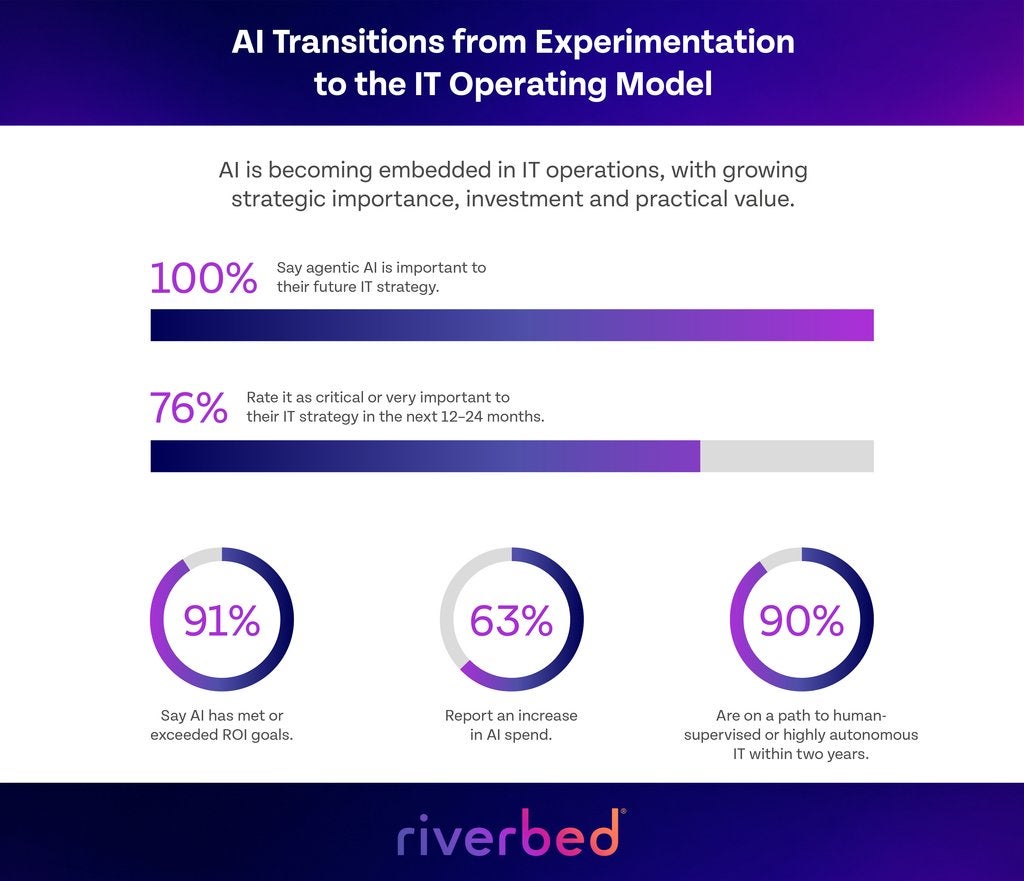
But adoption at any real scale is still limited. Just 19% of IT operations are automated today, only 8% of organizations report enterprise-wide AI-enabled operations, and just 9% of AI projects are fully deployed. The message is pretty clear: organizations have high hopes for AI, but they’re behind on operational readiness.
Trust Is the New Imperative
Moving from AI experimentation to autonomous IT operations requires confidence in the decisions AI makes, and that confidence isn’t there yet. Seventy-seven percent of respondents say their organization is hesitant to let AI make operational decisions without human approval. Security and compliance concerns (55%), the risk of operational disruption (45%) and lack of trust in AI decisions (39%) top the list of challenges.
That tracks with what I hear from customers. Very few want to flip a switch to full autonomy; 69% of respondents told us they want autonomous operations supervised by people, versus just 21% who want IT fully self-managed. That’s how we designed Riverbed IQ. Teams can start with AI-driven insights and recommendations, move to automations IT approves, and progress to autonomous remediation within guardrails IT defines, at whatever pace their confidence allows. Our customers executed more than 250 million AI-driven automation steps last year, and that kind of scale only happens when people can see and control what AI is doing.
The Foundations of Autonomous IT
Respondents point to three foundations for autonomous IT: high-quality data, unified observability and consolidated tools. On all three, most organizations still have work to do.
Data and Visibility: A 79-Point Reality Gap
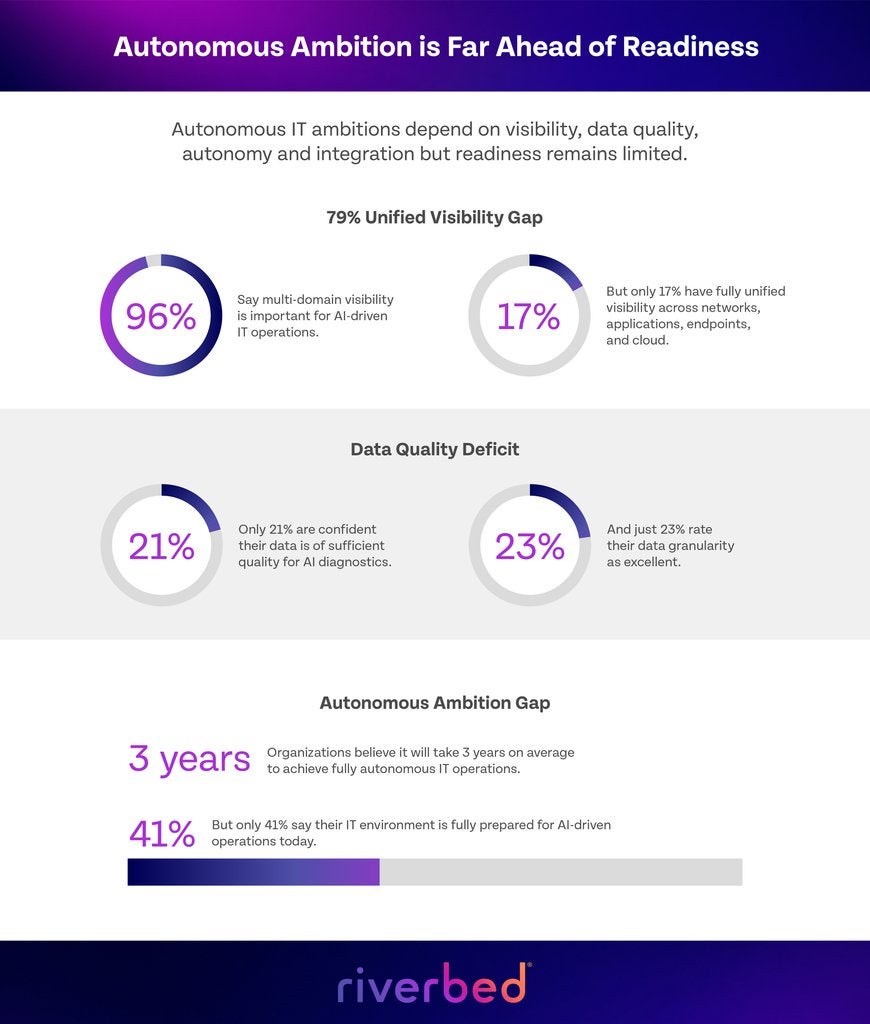
AI-driven decisions depend on accurate, real-time information, yet only 19% of organizations say they’re very effective at collecting the high-fidelity, real-time data those decisions require. Visibility shows a similar gap. 96% agree that multi-domain visibility across devices, networks, clouds, applications and remote endpoints is essential for AI-driven IT operations, but only 17% have achieved it. That’s a 79-point gap between what organizations believe they need and what they actually have.
Closing that gap is the problem Riverbed has spent more than 20 years working on. AI is only as accurate as the data it can see, so the Riverbed Platform captures full-fidelity telemetry (not sampled data) across users, devices, applications, networks, infrastructure and cloud, and brings it together in context in the Riverbed Data Store. That gives AI what it needs to correlate evidence, find root cause and act, rather than guess.
Tool Sprawl Continues to Create Friction
Fragmentation is the third barrier. Ninety-one percent of organizations believe tool consolidation would reduce operational friction, yet 87% say they still need to integrate systems and tools to make their AI deployments successful. It’s a technical debt problem: an industry analyst recently shared that the average large enterprise has 23–28 observability tools alone, including open source!
Consolidation is an easy answer to point to, but much harder to do on your own. That’s where Riverbed comes in. The Riverbed Platform brings observability together on a single data foundation, with a unified agent on the endpoint, so teams can retire overlapping tools instead of integrating yet another one. And because it’s open, with OpenTelemetry support and pre-built integrations into tools like ServiceNow, Microsoft Teams and Slack, it works with the tools you decide to keep.
AI Creates a New Operational Challenge
Organizations aren’t just using AI to manage IT. They now need to manage AI itself. Only 42% are very confident in their organization’s governance and oversight of AI usage, 51% say they lack sufficient oversight of AI agent performance, and 49% are concerned about how employees are using AI. Not surprisingly, 92% agree that AI observability and governance will become a critical new IT domain to manage.
It’s one reason we introduced Riverbed AI Assurance this year. It gives IT visibility into which AI tools employees are actually using, sanctioned or not, how AI agents are behaving across business workflows, and what all of it costs. You can’t govern what you can’t see, and that’s as true for AI as for any other part of the IT estate.
From Ambition to Autonomous IT
The journey toward autonomous IT operations is already underway, but ambition alone won’t deliver it. The journey will also reshape IT teams: 93% of respondents expect AI-powered operational intelligence to impact frontline IT and service desk capabilities over the next two years, and a third expect those roles to shift from reactive support to proactive prevention. That isn’t AI replacing IT teams. It’s AI handling more of the routine work so people can focus on complex problems and higher-value initiatives.
To turn that ambition into reality, organizations need to:
- Build trusted, real-time data
- Achieve unified observability with fewer tools
- Establish strong AI governance with continuous monitoring of AI
- Maintain human oversight that builds trust over time
The next phase of AI will require more than automation. It will require AI that enterprises can understand, trust and govern.
Explore the Full Findings
Download The State of Autonomous IT Operations to explore the full findings from 1,200 business decision-makers, IT leaders and technical specialists across seven countries.