
The Path to Autonomous Network Operations
Part 4 of a Four-Part Series: From Reactive NetOps to Predictive Operations

- By Heidi Gabrielson
- 06-Oct-2026
Most network operations teams still work reactively.
Today, an alert fires or a user reports a problem. Then, a NetOps engineer gathers the evidence, diagnoses the problem, determines the fix, executes it, and validates the outcome.
Intelligent Network Observability creates a path to a new operating model, with AI taking on more of that work.
Initially, AI can diagnose the problem and recommend remediation while the operator retains control. As confidence grows, AI can execute approved remediations. Then, for trusted, well-understood scenarios, organizations can authorize AI to detect, diagnose, remediate, and validate automatically.
Over time, AI can move even earlier in the process, identifying emerging conditions and helping NetOps address them before they disrupt users.
The Foundation for Autonomy
Autonomous operations start with the capabilities we explored earlier in this series: complete network evidence, connected context, AI-powered diagnosis, remediation, and validation. Together, these capabilities give AI the evidence and context to understand what’s happening, determine the likely cause and impact, recommend the appropriate remediation, and verify the outcome.
However, technical capability alone shouldn’t determine what organizations automate. Instead, organizations need to decide how much authority to give AI for each use case.
Autonomy Advances Use Case by Use Case
Organizations can progressively expand AI’s role based on the risk, confidence, and requirements of each scenario:
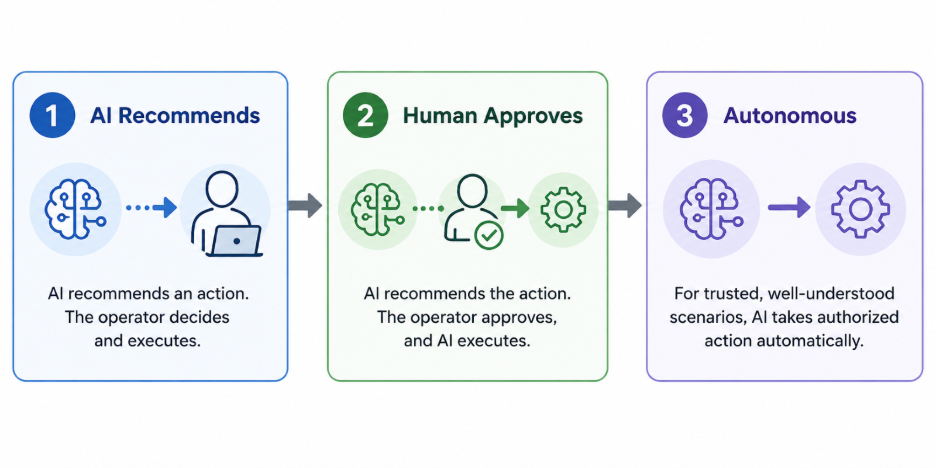
Autonomy isn’t an on/off switch. For example, organizations may trust AI to remediate a routine, well-understood issue autonomously, while requiring human approval for a higher-risk change.
Ultimately, organizations determine the appropriate level of autonomy for each use case and define the policies, permissions, and guardrails that govern how AI operates.
Validation Builds Confidence
Validation plays a critical role in increasing autonomy.
After remediation, IT can use active testing to verify the fix and confirm that performance has returned to expected levels. By building validation directly into the workflow, NetOps can also confirm that automated remediation achieved the intended outcome.
In turn, this closed loop helps organizations build confidence in AI-driven operations and expand automation to more use cases over time.
From Reactive to Predictive
As autonomy increases, NetOps can also move earlier in the problem lifecycle.
Instead of waiting for an alert or user complaint, AI can continuously evaluate network conditions, identify emerging problems, assess their likely impact, and recommend or initiate an authorized response before those problems disrupt users.
As a result, the operating model begins to shift:
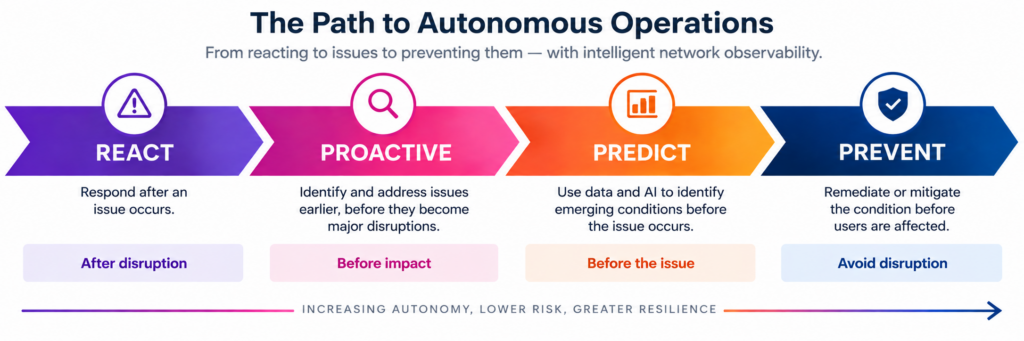
NetOps can spend less time manually investigating routine problems and more time governing automation, addressing complex issues, and improving network resilience.
The Destination: Autonomous Network Operations
Ultimately, autonomy serves a larger goal: minimizing disruption to users and the business.
Autonomous Network Operations moves NetOps from reacting to problems after they occur toward identifying issues earlier, resolving them faster, and increasingly preventing disruption.
Of course, organizations will progress at different speeds and assign different levels of autonomy to different use cases. However, they share the same destination: Network operations that spend less time reacting to disruption and increasingly predict and prevent it.
Click here to learn more.
