
OpenTelemetry Is Essential for Modern Application Observability
Riverbed Smart OTel makes OpenTelemetry practical for enterprise-scale application observability.

- By Heidi Gabrielson
- 29-Jun-2026
Application environments have changed dramatically. Enterprises now operate hundreds of applications spanning cloud‑native services, Kubernetes platforms, hybrid infrastructure, long‑lived enterprise systems, and increasingly, AI‑driven workflows. These applications underpin customer experience, revenue, and internal operations—yet most organizations still observe only a small fraction of them at code-level depth.
The constraint isn’t desire or awareness. It’s the economic and operational reality of applying deep observability across modern application environments at scale. That’s why OpenTelemetry (OTel) is emerging as a critical foundation for modern application observability.
The Observability Gap Most Enterprises Live With
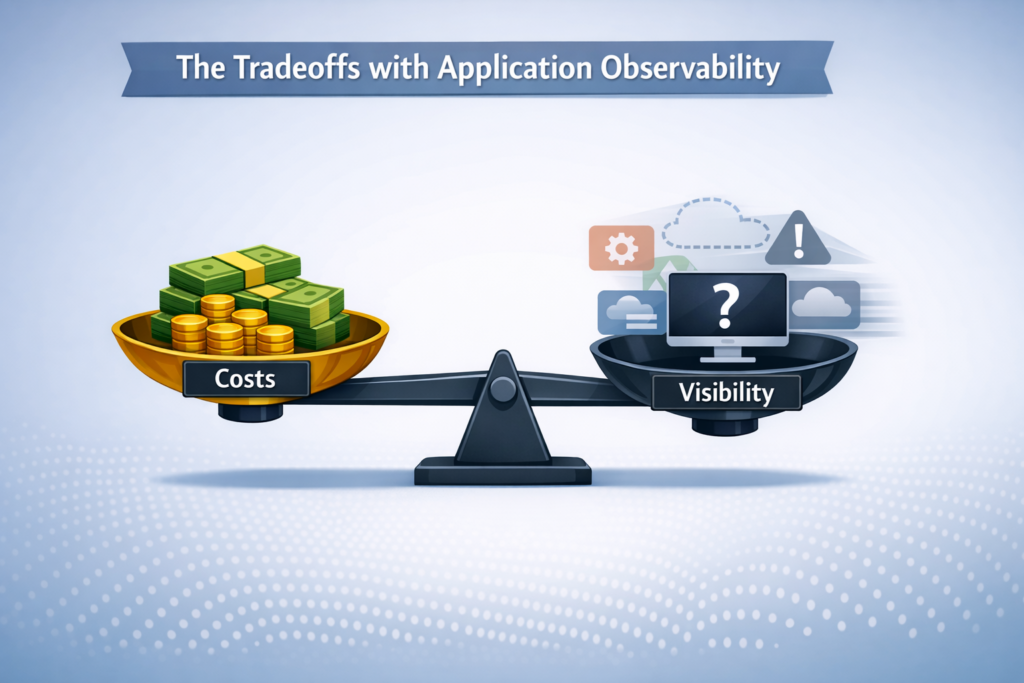
As application environments scale, traditional APM approaches become economically impractical to apply broadly, forcing teams into difficult tradeoffs:
- Focus deep instrumentation on tier‑one applications, leaving the long tail largely invisible
- Or absorb pricing tied to telemetry volume to deploy more broadly
The result is a fragile operating model. Teams pay heavily for observability but still face blind spots across much of the application portfolio. When incidents occur outside the handful of deeply instrumented services, troubleshooting becomes slow, manual, and dependent on guesswork.
As environments become more distributed—and as AI workflows introduce new dependencies and execution paths—these blind spots only multiply.
Why OpenTelemetry Changes the Game
OpenTelemetry fundamentally shifts what’s possible. As an open, vendor‑neutral standard, it makes deep, consistent instrumentation feasible across the entire application estate, not just a select few services.
With OpenTelemetry, teams gain:
- Standards‑based instrumentation across languages, frameworks, and platforms
- Freedom from proprietary agents and data formats
- The ability to instrument cloud‑native, hybrid, and legacy environments consistently
- A common telemetry foundation that can evolve as architectures change
Most importantly, OpenTelemetry removes the structural barriers that historically limited observability coverage. It becomes realistic to instrument all applications, not just what the budget allows.
This is a necessary step toward modern application observability, but it’s not sufficient on its own.
The Hidden Challenge of “Instrument Everything”
OpenTelemetry makes it technically possible to capture telemetry everywhere. At enterprise scale, however, raw telemetry volume grows fast—and often uncontrollably.
As coverage expands:
- Trace volume increases exponentially
- Storage and ingestion costs rise
- Signal‑to‑noise ratio drops
- Operations teams struggle to find what actually matters
Streaming all raw telemetry downstream without governance simply shifts the problem. Instead of blind spots, teams face data overload, higher costs, and operational complexity that undermines the very value observability is meant to deliver.
This is where many organizations stall. Open instrumentation without intelligent control becomes unsustainable.
The Missing Layer
OpenTelemetry makes it possible to instrument everything, but at enterprise scale, raw telemetry quickly becomes overwhelming. As teams expand instrumentation across applications, services, and AI workflows, telemetry volume grows exponentially, driving higher storage costs, increased noise, and operational complexity. Without controls at the point of collection, “open” observability can become unsustainable.
Riverbed Smart OTel is purpose‑built to solve this problem.
Smart OTel is Riverbed’s intelligent telemetry governance technology, designed to turn open instrumentation into scalable, enterprise‑grade observability. Instead of streaming unfiltered telemetry downstream, Smart OTel applies intelligence at the point of collection, filtering, enriching, and shaping telemetry in real time—before data overload becomes an issue.
With Smart OTel, Riverbed ensures:
- High‑value signals are preserved at full fidelity, including complete transaction context
- Low‑value, redundant, or noisy data is intelligently reduced or filtered
- Trace depth and execution context are maintained, even as coverage expands
- Telemetry volume and cost remain predictable and controlled
This approach allows organizations to confidently scale OpenTelemetry instrumentation across their entire application estate, without runaway observability costs or sacrificing the depth required for fast, accurate troubleshooting.
Crucially, Smart OTel is built on open OpenTelemetry standards. Telemetry remains portable, vendor‑neutral, and aligned with OpenTelemetry as observability strategies, architectures, and tools evolve—while benefiting from Riverbed’s intelligence and operational expertise.
From Raw Signals to Operational Intelligence
When OpenTelemetry is paired with Smart OTel, observability moves beyond basic monitoring.
Teams gain the ability to:
- Preserve complete transaction context across applications and dependencies
- Detect degradation early through correlated signals and baselines
- Move directly from alert to root cause using captured execution context
- Extend observability into AI agents and workflows, making AI behavior transparent and diagnosable
This intelligent telemetry foundation also enables higher‑order capabilities such as AI‑assisted root cause analysis, guided remediation, and over time, more autonomous operations.
Modern enterprises don’t run tens of applications; they run hundreds. Observability strategies must scale accordingly.
Observability That Finally Scales with the Business
OpenTelemetry provides the openness and flexibility required to instrument everything. Riverbed Smart OTel ensures that doing so remains economically viable, operationally manageable, and analytically useful.
Together, they eliminate the historic tradeoff between depth and breadth, making it possible to achieve full‑fidelity application observability across the entire application estate, not just the most critical services.
That’s the difference between limited monitoring and real production‑level understanding, where every transaction, every dependency, and every user impact is visible when it matters.
To learn how Riverbed APM+ supports OpenTelementy, click here.
